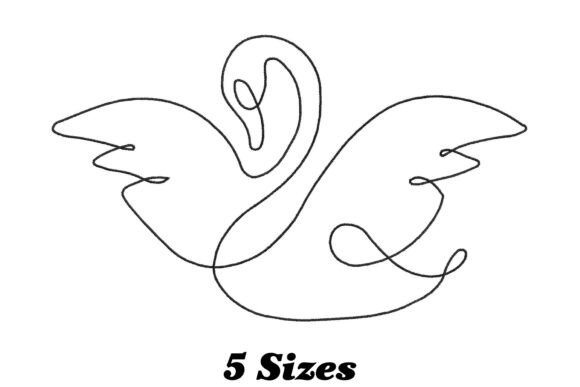
Swan Outline: Graceful, Not Fussy
As a designer who’s stitched hundreds of embroidery files for clients—from boutique baby brands to Etsy sellers launching their first embroidered tote line—I opened Swan Outline expecting elegance. What I got was something more useful: quiet confidence. This isn’t a fussy, over-detailed bird meant for gallery framing. It’s a clean, single-contour silhouette—fluid, balanced, and instantly legible at 3–4 inches tall. The curve of the neck flows into the body without sharp angles or awkward breaks. No wings flaring, no feathers rendered in satin stitch—just one continuous, unhurried line. That simplicity is its strength.
Where Swan Outline Feels Like Home (and Where It Doesn’t)
I tested Swan Outline on three real projects last week: a linen tea towel for a local kitchen shop, a cotton twill apron for a baker’s small-batch brand, and a soft organic cotton onesie for a newborn gift set. On the towel? Perfect—crisp, airy, and unmistakably graceful against the natural weave. On the apron? It held up beautifully near the pocket edge, where fabric tension stays even. But on the onesie? I paused. The neckline curve and stretch of knit fabric made me rethink placement—centered on the chest, yes, but only with light cutaway stabilizer and reduced top tension. Swan Outline doesn’t demand heavy backing, but it *does* ask for thoughtful fabric pairing.
This design shines brightest on stable, medium-weight fabrics: quilting cotton, canvas, terry cloth, twill, and midweight linen. It’s ideal for custom apparel like sweatshirts and tote bags—especially when you want subtlety over statement. It reads as handmade, not mass-produced. But avoid it on highly textured surfaces (like bouclé or thick terry loops), ultra-thin voile (where the outline might blur), or curved cap fronts unless you’re using a cap frame and have confirmed hoop compatibility. The lack of interior detail means it won’t compete visually with busy backgrounds—but it also won’t hide flaws in uneven stitching or poor stabilizing.
What Customers Actually Notice (and Why That Matters)
Here’s what surprised me: people didn’t say “Oh, it’s a swan.” They said, “It feels calm.” “It looks intentional.” “It makes the towel feel special—not decorated.” That’s the quiet power of Swan Outline. In a market flooded with dense floral fills and cartoonish birds, this design communicates refinement through restraint. For an Etsy seller listing personalized baby embroidery, that translates directly to perceived value—and trust. A parent buying a nursery pillow cover doesn’t need realism; they want serenity, continuity, and craftsmanship. Swan Outline delivers that without shouting.
It also scales well. At 2.5 inches, it works cleanly on a patch or cap front. At 5 inches, it anchors a pillow cover without overwhelming. And because it’s purely outline-based—no fill stitch, no satin borders—it avoids common pitfalls: thread buildup, puckering on lightweight fabric, or density-related shifting during stitching. That reliability matters whether you’re producing five holiday gifts or fifty wholesale aprons.
Practical Designer Notes You’ll Want Before Stitching
Before committing to your first finished product, run these checks:
- Test on scrap fabric—especially if using dark thread on light fabric or vice versa. Outline designs rely entirely on contrast for impact.
- Review stitch density in your embroidery software. Even simple outlines can run too fast or too slow depending on machine settings—adjust speed and tension to match your fabric weight.
- Confirm hoop size and placement. Because the shape is tall and narrow, centering it on curved or tapered items (like a tote strap or sleeve cuff) requires careful digitizing prep—or manual repositioning.
- Inspect corners and curves at actual stitch-out size. Some machines interpolate long curves differently; check that the neck-to-body junction stays smooth, not jagged.
- Try black-and-white mockups before finalizing listings. Swan Outline gains clarity in monochrome—it’s why it works so well for minimalist branding.
- Compare light and dark fabric backgrounds. On charcoal linen, navy thread reads as rich and grounded. On ivory cotton, ecru or pale gray thread gives airiness. Avoid matching thread to fabric tone—it disappears.
- Use appropriate stabilizer: tear-away for stable wovens, light cutaway for knits or loosely woven towels. Skip heavy fusibles—they mute the delicate line quality.
- Verify licensing before selling finished items or bundling Swan Outline as part of a digital embroidery file pack. As a craft business owner, this protects your reputation and revenue.
When to Reach for Swan Outline (and When to Pause)
Reach for Swan Outline when you need: a signature motif for a boutique’s tea towel collection, a subtle logo alternative for a wellness brand’s apparel line, a tender addition to baby embroidery sets, or a cohesive element across holiday embroidery—think swans on linen napkins, sweater cuffs, or ceramic mug sleeves (embroidered onto fabric sleeves, of course). It’s equally strong in digital embroidery file previews and printable mockups, thanks to its clean vector-like readability.
Pause if your project demands high detail (like feather texture or layered applique), needs to survive industrial laundering cycles without re-stitching, or must fit inside a 3-inch hoop with zero margin for adjustment. Also reconsider for products where recognition depends on instant familiarity—Swan Outline leans poetic, not literal. It’s a Birds design, yes—but it’s really about mood, rhythm, and restraint.
In short: Swan Outline isn’t just another machine embroidery design. It’s a design decision—one that says you value clarity over clutter, intention over ornament, and quiet grace over flash. For the Etsy seller building a thoughtful brand, the small shop product curator, or the handmade product maker who stitches with purpose—it’s not just usable. It’s trustworthy.